Product management case study
Building a Real Estate Media Workflow Platform
A product management case study on identifying a fragmented workflow, repositioning the acquisition strategy around photographers, and building a working SaaS MVP with AI-assisted media operations.
- Role
- Founder & Product Lead
- Scope
- Product strategy, customer discovery, UX, technical architecture, AI integration, analytics
- Status
- MVP launched and in early validation
Overview
PropertyMediaHQ is a workflow platform for organizing real estate listing media before and after it reaches downstream marketing systems. I led the product from initial hypothesis through customer discovery, strategy revision, MVP definition, and launch.
This case study documents product decisions, tradeoffs, and execution — not a fundraising narrative. The focus is on how I identified a fragmented workflow, changed course based on discovery, and shipped a focused MVP that could be validated with real users.
The Problem
Real estate media operations are split across too many disconnected tools. A typical listing may involve:
- Photographer delivery portals and ad hoc file transfers
- Cloud storage folders with inconsistent naming and permissions
- MLS systems that compress and limit asset flexibility
- Brokerage websites, social tools, and print vendors each needing separate packages
- Marketing teams rebuilding assets because source media is hard to find
The result is rework, quality loss, and slow time-to-market. Agents and marketers often receive media late, in the wrong format, or without the context needed to publish across channels efficiently.
Key Product Insight
Photographers sit earlier in the workflow than MLS systems — and they are the media supply chain.
My initial assumption positioned MLS integrations as the center of gravity. Discovery showed that higher-quality source media is created and controlled before MLS upload. Winning the photographer workflow improves asset quality, reduces downstream rework, and creates a more defensible entry point than competing on MLS plumbing alone.
This insight reframed go-to-market: acquire photographers first, make delivery operationally excellent, then expand value for agents, marketers, and brokerage teams on top of organized property workspaces.
Customer Discovery
I ran structured conversations with photographers, agents, marketing coordinators, and brokerage operations leads. The goal was to validate workflow pain, not pitch features.
Core questions included:
- Where does media break down between shoot delivery and listing launch?
- Who owns organization today, and what tools are actually used?
- What would make a photographer adopt another platform?
- Which outputs matter most in the first 48 hours after a shoot?
Patterns emerged quickly: photographers want low-friction delivery; agents want one place per property; marketing teams want reusable packages, not one-off folder links. MLS integration was repeatedly described as important but not the first bottleneck.
Product Strategy
I prioritized a photographer-first wedge with a property workspace as the shared object model. Every listing becomes a durable media hub that can feed channel packages over time.
Monetization principles I used for sequencing:
- The free tier should feel operationally complete for core upload, organization, and delivery workflows.
- Paid value should align with scale, collaboration, automation, advanced channel packages, archival intelligence, and brokerage/team operations — not basic usability.
- Defer marketplace, billing complexity, and enterprise DAM until the core workflow proves retention.
This reduced early engineering risk while keeping a credible path to expansion revenue without undermining adoption.
MVP Scope
I defined MVP scope explicitly to protect speed and learning velocity. The objective was to validate workflow value, not build a full platform on day one.
Included
- ✓Property-level media workspace
- ✓Photographer upload and delivery flow
- ✓Media gallery and asset organization
- ✓Channel package structure
- ✓AI-assisted captions and listing copy
- ✓Basic analytics and funnel visibility
Intentionally excluded
- —Billing and payments
- —Marketplace features
- —Complex role hierarchies
- —Enterprise DAM capabilities
- —Heavy MLS integrations
Architecture
I designed the stack for fast iteration, clear ownership boundaries, and low operational overhead at MVP scale.
High-level system choices:
- Next.js + Vercel for marketing site and app surfaces with shared TypeScript types.
- Supabase for auth, relational data, and workspace metadata.
- Uploadcare for resilient large-file ingestion from photographers.
- OpenAI for assisted captions and listing copy grounded in property context.
- Plausible for privacy-friendly funnel analytics on marketing and onboarding paths.
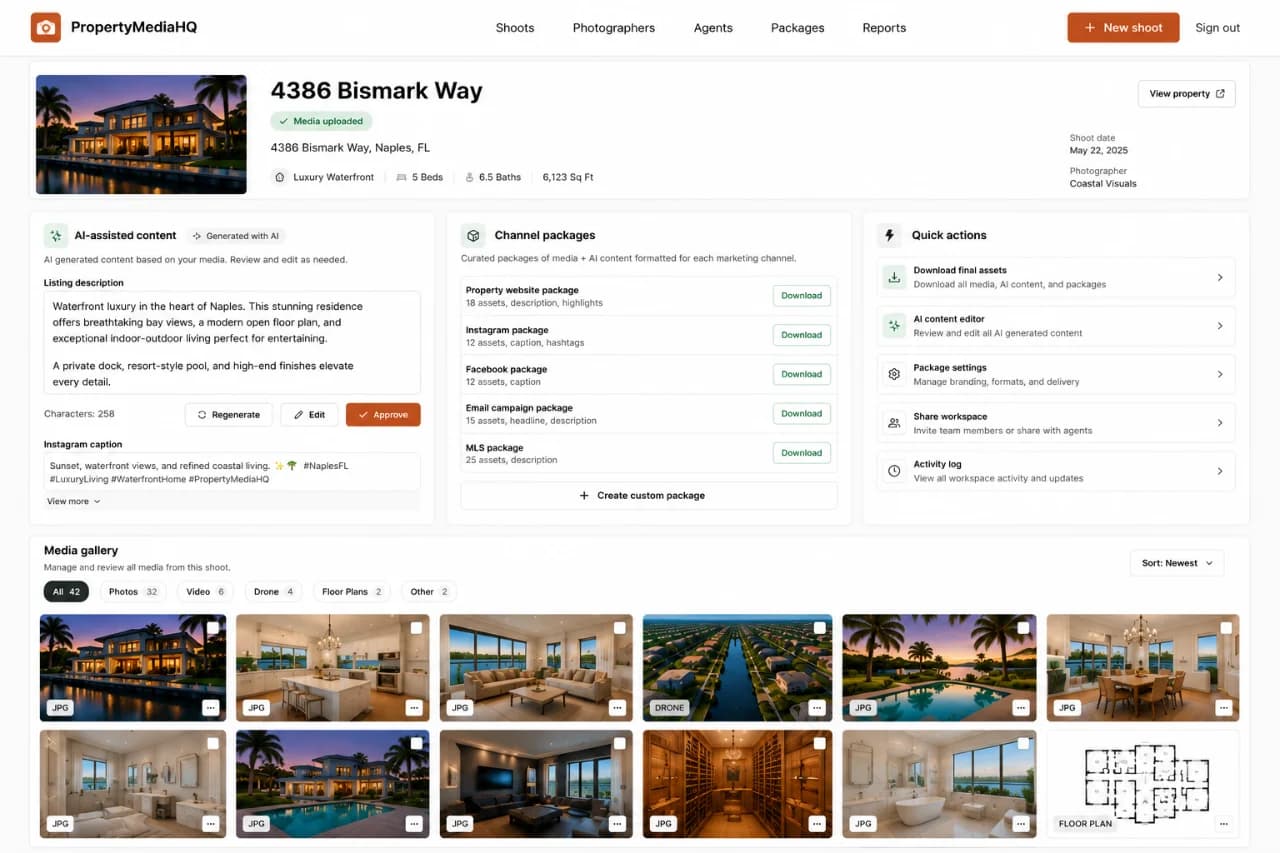
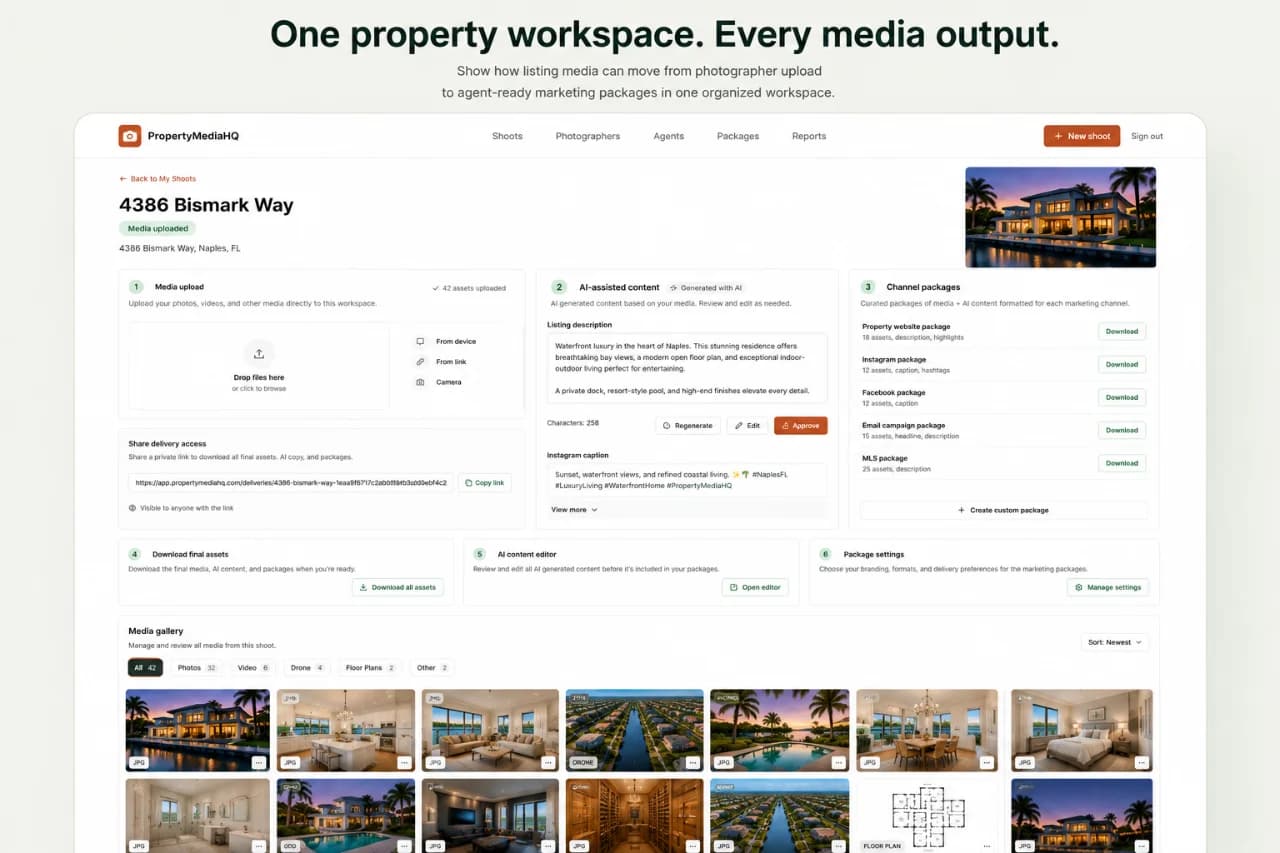
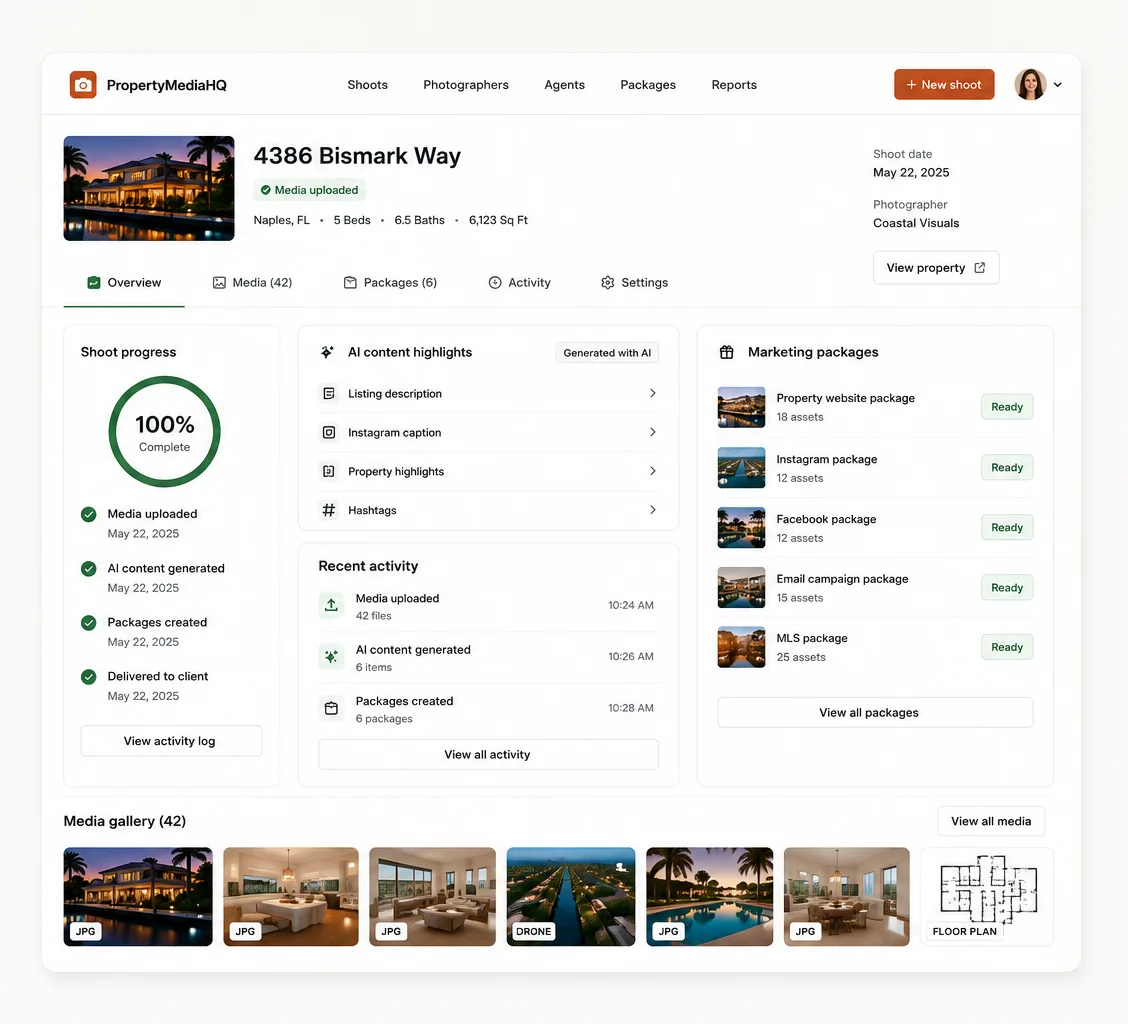
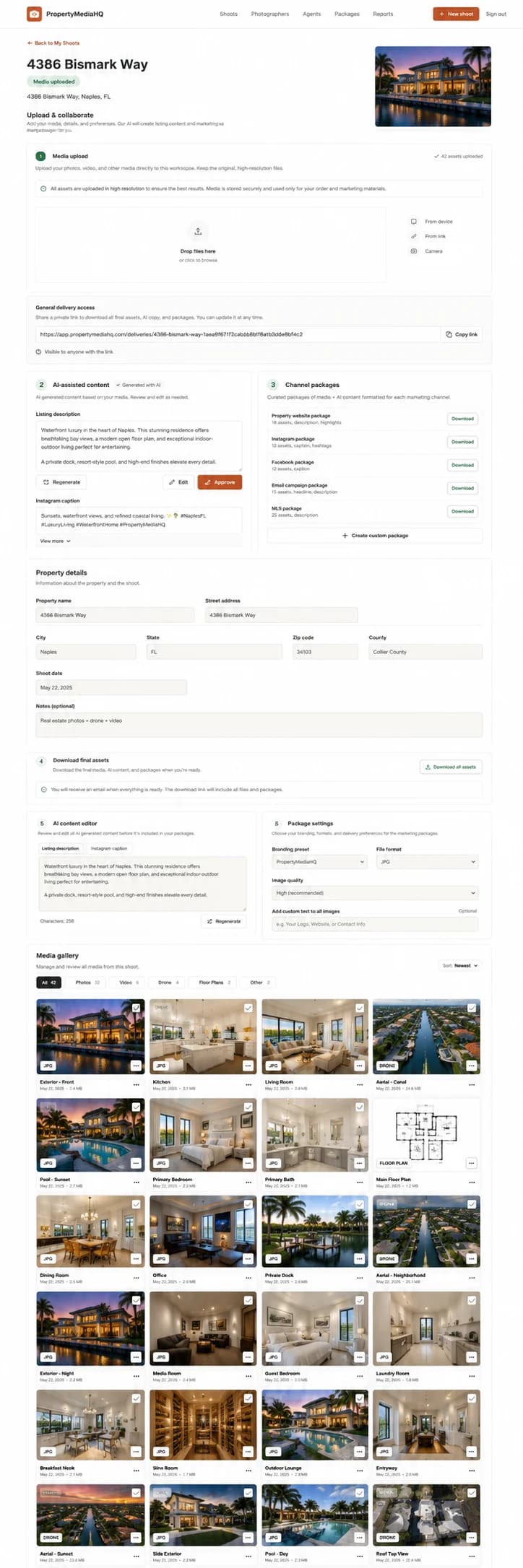
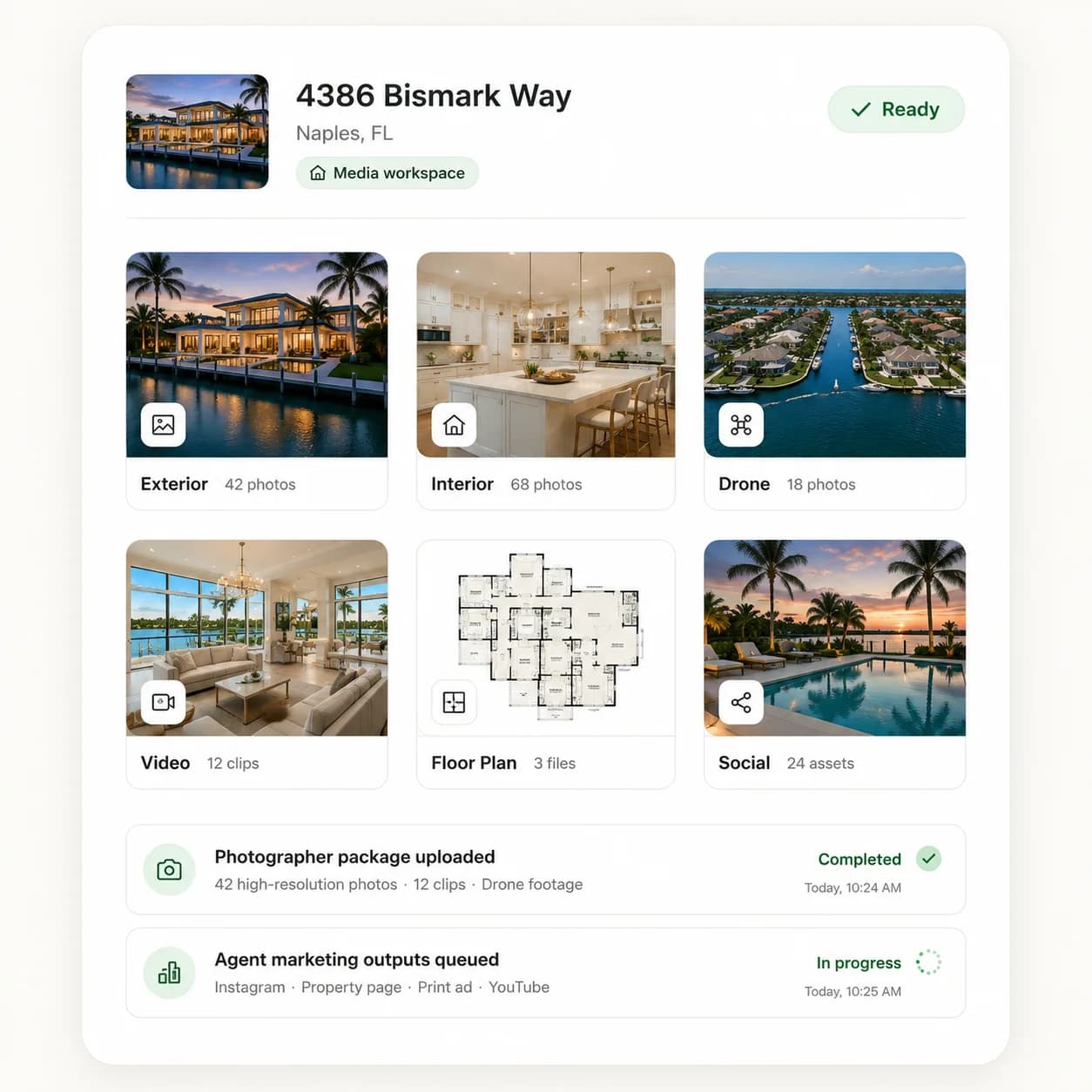
Product Screenshots
Selected screens that reflect product decisions, not just UI polish.
Results & Progress
The MVP is live and in early validation. I am measuring adoption through photographer onboarding completion, repeat property workspace usage, and qualitative feedback on delivery quality.
- Shipped end-to-end workflow from upload to organized property workspace
- Launched AI-assisted content generation tied to listing context
- Established analytics baseline for acquisition and activation funnels
- Iterating onboarding based on early photographer feedback
I am intentionally conservative about claiming scale metrics at this stage. The current focus is learning whether the workflow reduces friction enough to earn repeat usage.
Lessons Learned
- Start with workflow ownership, not integrations. MLS connectivity matters, but it is not always the first bottleneck. Solving upstream media intake created clearer MVP boundaries.
- Scope discipline accelerates learning. Removing billing, marketplace, and enterprise DAM features early kept the team focused on validating the core job-to-be-done.
- Free tier design is a product decision. Making core operations feel complete improved trust, while reserving monetization for scale and advanced operations avoided adoption friction.
- AI should reduce operational drag, not add novelty. Captions and listing copy performed best when grounded in property media context and editable by users.
My Role
As Founder & Product Lead, I owned problem framing, discovery synthesis, roadmap prioritization, UX direction, and launch execution.
- Defined product vision, positioning, and MVP boundaries
- Led customer interviews and translated insights into roadmap changes
- Designed core workflows and information architecture
- Partnered on technical architecture and AI feature integration
- Implemented analytics and iteration loops for onboarding and activation
- Shipped marketing site and product surfaces for early validation
Explore the product
See the live MVP and marketing site referenced in this case study.